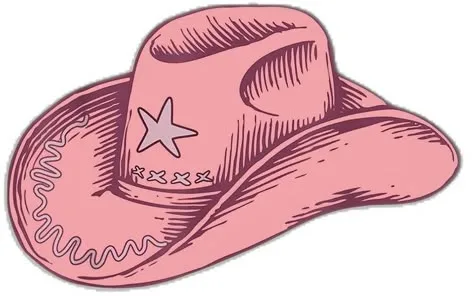
A good cowboy hat drawing looks confident, even when it’s simple. The trick isn’t fancy detail, it’s getting the brim and crown to sit right, like a real hat resting in space instead of floating on the page.
In this guide, you’ll learn a beginner-friendly process: start with basic shapes, build the brim and crown, clean up your lines, then add shading and small details (band, crease, texture) that make it feel real.
These steps work the same whether you’re using pencil, pen, or a drawing app. The order stays the same, you just change tools.
Materials and setup for an easy cowboy hat drawing
You don’t need much to draw a cowboy hat well. Start simple so you can focus on shape.
Here’s a solid setup:
- A pencil (HB or 2B) for sketching
- A good eraser (kneaded is nice, any clean eraser works)
- Plain paper or a sketchbook
- Optional: a fine liner for final lines
- Optional: colored pencils or markers for color
- Optional: a blending stump or tissue for soft shading
Pick a reference photo if you can. It keeps your brim curve honest.
- Front view references help you learn symmetry and the band placement.
- Side view references make brim curl and crown angle easier to see.
- Use a photo with clear lighting and a simple background, so shadows are easy to read.
Before you start, warm up your hand for 20 seconds. Make a few light ovals and long curves. Keep pressure low. Also, draw big at first. A larger hat sketch makes it easier to control smooth curves and fix proportions.
Pick a cowboy hat style before you start (classic, cattleman, or straw hat)
Different styles change the “silhouette,” which is the outline that sells the hat at a glance.
- Classic cowboy hat: a gently curved brim, a crown with a simple crease, and a clean hat band.
- Cattleman hat: the easiest to recognize, with a center crease running front to back and two subtle “bumps” on the sides.
- Straw hat: a wider, flatter brim, often less curled, with a lighter feel and more visible texture.
If you’re new, start with a cattleman shape. It has clear landmarks, so you’re less likely to get lost in random curves.
Common drawing mistakes to avoid early
Small errors early can make the whole hat feel off. Watch for these and fix them fast:
- Drawing too dark too soon: keep your first lines light so you can adjust.
- Tiny brim: most cowboy hats have a brim that feels wider than you think.
- Uneven curves: flip your sketchbook or look at it in a mirror to spot lopsided sides.
- Brim thickness drawn the same everywhere: thickness changes with angle and tilt.
- Hat band placed too high: it usually sits near the base of the crown.
- Forgetting the underside of the brim on a tilted hat: without it, the hat looks flat.
Step by step cowboy hat drawing, from basic shapes to clean lines
Start with structure, not details. Think of the hat as two main parts, a wide brim and a crown sitting on top. Keep checking the centerline so both sides stay balanced.
- Set a light center guideline. Draw a faint vertical line where the hat will be centered. For a 3/4 view, tilt this line slightly to match the hat’s angle.
- Block in the brim as an oval. Don’t worry about cowboy curl yet. Just get a wide oval on the page. If you’re drawing a front view, keep both sides even. If it’s a 3/4 tilt, the oval will look narrower, and the far side will feel more “compressed.”
- Mark the crown footprint. Inside the brim, sketch a smaller oval or rounded shape where the crown connects. This helps stop the crown from looking glued on.
- Build the crown with a simple block. Think “soft box” or rounded rectangle. Make it wider at the base and slightly narrower near the top. Keep it sitting firmly on that crown footprint, not floating above it.
- Refine the cowboy hat silhouette. Now you can start turning the oval brim into a cowboy brim, adding the upturns and dips. Then adjust the crown curve so it feels smooth and solid.
- Add the hat band and key seams. Wrap a band around the base of the crown. On a 3/4 view, the band curves more on the far side. Add a small buckle or concho later if you want.
- Clean lines last. Once the shapes feel right, erase extra guides. If you’re in pencil, darken the final outline with cleaner strokes. If you’re in ink, trace slowly and let the sketch stay light underneath.
Sketch the brim with a wide oval, then show the curve and thickness
A brim is basically an ellipse, like a flattened circle. Draw it lightly, then “cowboy-ify” it.
For a front view, keep the brim symmetrical. Add a slight dip in the front or back (your choice), then turn the sides up a bit. The upturn should be gentle, not like a sharp wave.
For a 3/4 tilt, the near side of the brim often shows more curve. The far side looks tighter and less open because of perspective. A quick check is to compare left and right spacing from the centerline.
To show thickness, draw a second line just inside the brim edge. Don’t keep the gap identical all the way around. Where the brim tilts toward you, you’ll see more underside, so the thickness reads stronger. Where it tilts away, the thickness nearly disappears.
If the hat is tilted down, add a light underside shape under the front brim. That small shadowed plane is what makes it feel 3D fast.
Build the crown with simple blocks, then add the crease and pinches
Place the crown like a sturdy form sitting on the brim. Start with a rounded rectangle or soft box. The base should be wider, then taper slightly toward the top.
Next, add the cattleman features:
- Center crease: draw a long, shallow dent running front to back on the top plane.
- Two side bumps: on each side of that dent, the top rises a bit.
- Front pinches: near the front corners, pinch the crown inward with two gentle curves.
To keep both sides even, use tiny “check marks.” Measure from the centerline to each pinch. If one pinch is farther out, nudge it in before you darken lines. Also, keep the crease centered. A drifting crease makes the hat look warped.
Add realism with shading, texture, and small cowboy hat details
Once the outline looks right, shading does most of the work. Pick one light direction (top-left is common) and stay consistent.
The big shadow areas on a cowboy hat are predictable:
- Under the brim (cast shadow)
- Inside crown creases (form shadow)
- Where the hat band meets the crown (a thin shadow line)
Keep your drawing clean as you shade. Rest your hand on scrap paper, and erase smudges early. If you plan to ink, finish all pencil shading first, or ink first and shade with colored pencil.
Shading that makes the hat look 3D (highlights, cast shadows, and edge control)
Put your darkest values where light can’t reach:
- Under the brim, especially close to the crown
- Inside the center crease and near the pinches
- Right under the band, where it touches the crown
Leave some paper showing for highlights on the top planes. A cowboy hat looks better with a few clean, bright areas instead of even gray everywhere.
Control your edges. Soft shading works on rounded areas. Sharper, cleaner edges work on felt folds and crisp brim rims. If you go too dark, lift highlights with an eraser by tapping, not rubbing.
Texture and details that sell the look (hat band, stitching, straw weave, wear marks)
Texture should suggest the material, not cover it.
For felt, use smooth shading with a few light strokes that follow the hat’s curve. Keep it subtle, felt doesn’t look scratchy.
For straw, use broken, light lines that wrap along the brim curve. Don’t draw every weave. Hint at it in a few zones, then let the rest breathe.
Easy details that add character:
- A band buckle or small conchos
- A few tiny stitching marks on the band
- Slight scuffs on the brim edge (small, uneven nicks)
- A faint sweatband line on the underside for a tilted view
Conclusion
A strong cowboy hat drawing comes from a clean build: start with a wide brim oval, place a simple crown block, add the crease and pinches, then refine the edges before shading. Once the structure is right, shadows under the brim and inside the crown do the heavy lifting.
Practice the same hat at two angles, a straight-on view and a 3/4 tilt, and use a clear reference photo each time. When you’re ready, try a straw version or add a simple desert horizon behind it for a more Western feel.

Related Posts