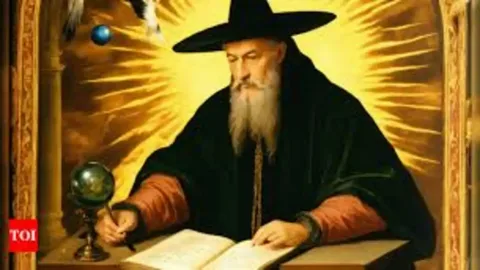
For nearly 500 years, the writings of Michel de Nostredame, better known as Nostradamus, have captivated the public imagination. The 16th-century French astrologer and physician published his book Les Prophéties in 1555, a collection of 942 poetic quatrains allegedly predicting future events. As we approach 2025, many turn to his cryptic verses, searching for clues about the year ahead. But what did Nostradamus actually say, and how do his prophecies relate to our modern world?
Who Was Nostradamus?
Born in 1503, Nostradamus lived during a time of great social and political upheaval in Europe. He was a respected physician who treated plague victims, but it was his work as a seer that secured his legacy. His prophecies were written in a mix of French, Latin, Greek, and Occitan, and filled with vague, metaphorical language. This ambiguity is a key reason why his predictions have been interpreted in so many different ways over the centuries. He organized his quatrains into “Centuries,” or groups of 100 verses, creating a vast and enigmatic body of work that continues to be studied and debated.
The Art of Interpretation
It is crucial to understand that Nostradamus did not attach specific dates to his predictions. Attributing his prophecies to a particular year, like 2025, is a modern practice. Scholars and enthusiasts analyze his quatrains and attempt to connect them to current events or anticipated future trends. These interpretations are speculative by nature. The language is so symbolic that a single verse could be applied to numerous situations across different eras. Therefore, any “prediction” for 2025 is a modern interpretation, not a direct forecast from Nostradamus himself.
Potential Predictions Interpreted for 2025
While no quatrain explicitly mentions “2025,” interpreters have highlighted several verses that they believe could be relevant to the coming year, often linking them to contemporary global concerns.
One commonly cited area of interpretation involves geopolitical instability. Some scholars point to verses that seem to describe naval conflict or a major global power facing significant turmoil. For example, quatrains mentioning battles at sea or a “great war” are often interpreted in the context of rising international tensions. These interpretations suggest 2025 could be a year of significant political shifts or escalating conflicts between nations.
Another theme frequently discussed is climate-related events. Nostradamus wrote of “great floods,” “scorching sun,” and “parched earth.” Given the increasing frequency of extreme weather events worldwide, interpreters suggest these verses could point to major environmental disasters in 2025. This could manifest as catastrophic flooding, widespread droughts, or other severe climate-related challenges affecting large populations.
Finally, some interpretations focus on technological or scientific breakthroughs. A few quatrains allude to new forms of healing or startling discoveries. Modern enthusiasts connect these vague references to rapid advancements in fields like artificial intelligence, genetic engineering, or space exploration. According to these views, 2025 could witness a discovery that fundamentally alters human life or our understanding of the universe.
Why We Remain Fascinated
The enduring appeal of Nostradamus lies in our inherent human desire to understand the unknown and find order in a chaotic world. His mysterious prophecies provide a framework for exploring our anxieties and hopes for the future. The vagueness of his writing allows each generation to see its own challenges and triumphs reflected in his words.
Whether his verses are genuine prophecies or simply skillfully crafted poetry, they act as a mirror. They encourage us to reflect on the state of our world—from political tensions and environmental worries to our relentless pursuit of knowledge. As we look toward 2025, the of are less about a fixed destiny and more about the ongoing story of humanity, a story we are all actively writing.

Related Posts